Has the #market bottomed ?

If anyone claims to have the answer to this question, they really don’t know what they are saying because the truth is nobody knows. So the best thing to do is to objectively assess what is going on, to invest responsibly and be patient.

This past week has been another rollercoaster with the US markets rallying more than 13% as you can see from the $SPY (an ETF which reproduces the SP500 index), however the #volatility has not moved much, with a weekly reduction of just over 1% (see $VXX the ETF which reproduces the VIX). This means that it is too early to call the bottom in my opinion.
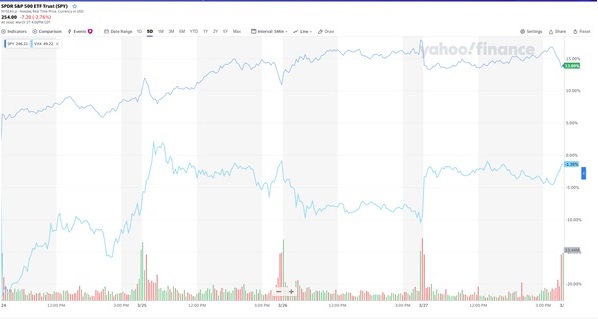
SPY

All investors who are predominantly long are obviously pleased to see this week’s jump, don’t get me wrong, but there are many examples of rallies which have followed large drops. Look at what happened during the 2008 crisis for example, there were 6 positive jumps between +9 and +19% on the way down. Before the market finally bottomed in Q1 2009 the volatility was greater than 30.
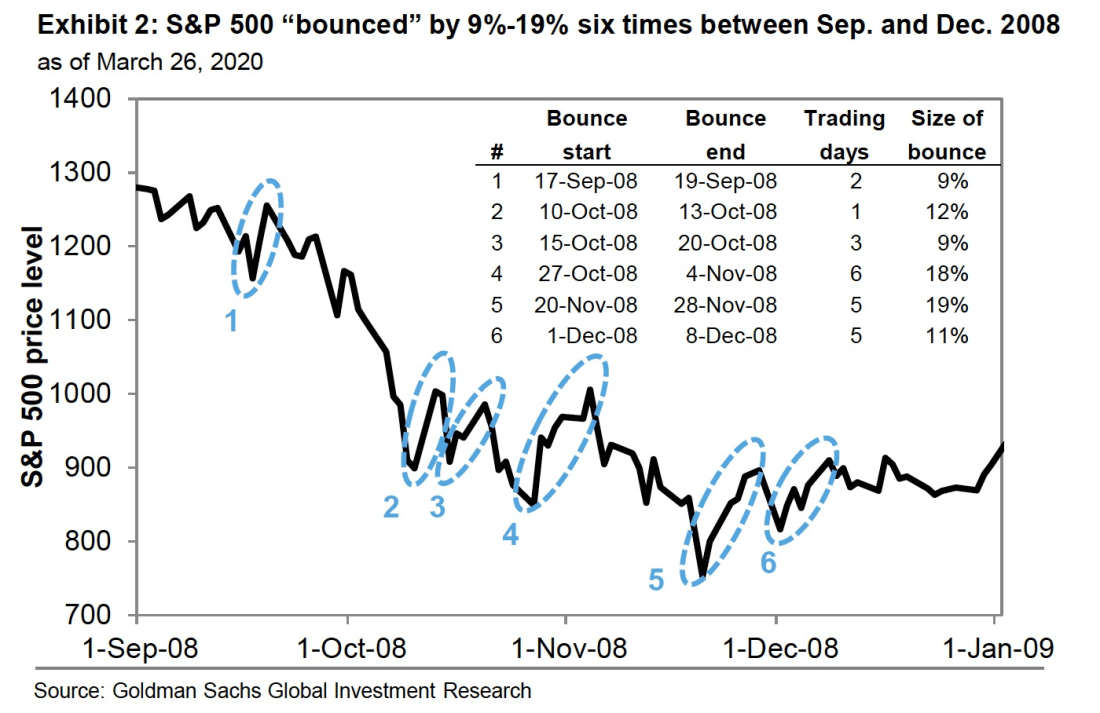
File 28-03-2020, 15.14.28

So what can investors do in the meantime ? Be patient and take one day at a time. As I have a long term horizon and the market has already dropped a lot, I did do some nibbling this past week, focusing on dividend payers with a good valuation such as $BMY, but I still have a large cash position overall as I don’t reckon it is time to go all in yet.

I have also increased my hedges, by upping my position on a double inverse SP500 by 50%. One might ask, why enter or increase a long position on a stock while at the same time increasing a short position ? The answer lies in the time horizon, once again. I invest long when there is upside potential in the long term (most of the times), whereas I introduce hedges when markets are volatile, therefore in the short term. If there is another drop next week, my loss will be reduced; if it goes up again, I will gain less but hedges are typically a smaller percentage of one’s portfolio so the loss is limited. In fact, I wish I could always lose on my hedges !!!

If you are interested in seeing what additional stocks I might get long on when the conditions are right, please keep reading my weekend updates !

Stay safe everyone and invest responsibly.
 

Has #volatility peaked ?

Has volatility peaked ? Difficult to say, what’s certain is that over the past 4 weeks the US markets have wiped out all the gains of the last 3 years, basically since Trump’s presidency started. Some say that coronavirus has only been the trigger of the neutralisation of a rally on steroids caused by liquidity injection and tax breaks, ie not of true #earnings growth. While more #liquidity is coming, it would appear that monetary policy alone is not going to be a sufficient cure for the market and that fiscal policy is also needed as well as an effective way to put an end to this biological crisis.

Intro over. So what can investors do in these difficult times ? Last week we talked about raising cash and inverse funds. The situation has not changed as volatility remains high although it has decreased from about 80 to about 60 this past week.

In the meantime, it helps looking at what the new earnings are saying. $ACN for example, a company on my watchlist, has beat expectations early this week but halved their revenue forecast. This company traditionally releases earning much earlier than most S&P companies, which are not due for a few more weeks.

Another interesting observation. The Norwegian krona has tanked and lost about 20% compared to the Euro in the past 20 days: that is a massive drop for a currency of a country with AAA rating ! #Norway has been seriously hit by the virus, is not part of the EU which prevents them from accessing the benefits of QE and is heavily reliant on $OIL which is down >50% over the past month. Not looking good for Norway, but is their currency a possible future investment opportunity when the situation stabilises ?

This week 3 of our long positions have hit the stop loss limit, namely $SYF, $RR.L and $OXY . It is very important not to let your losses run beyond 7 to 20%, depending on your risk profile and whether they are dividend payers or not, so it is advisable to insert suitable stop losses, thankfully this is function that works well on many trading platforms. I continue to watch $SYF closely as I think there will be a great buying opportunity in the not too distant future, whereas I think $RR.L will be under prolonged pressure due to their reliance from the aviation industry and $OXY won’t recover until $OIL rebounds unless they are taken over.

As always, be patient and invest responsibly !

Happy weekend to all.

#Valuation drives the #market: which strategy for 2020 ?

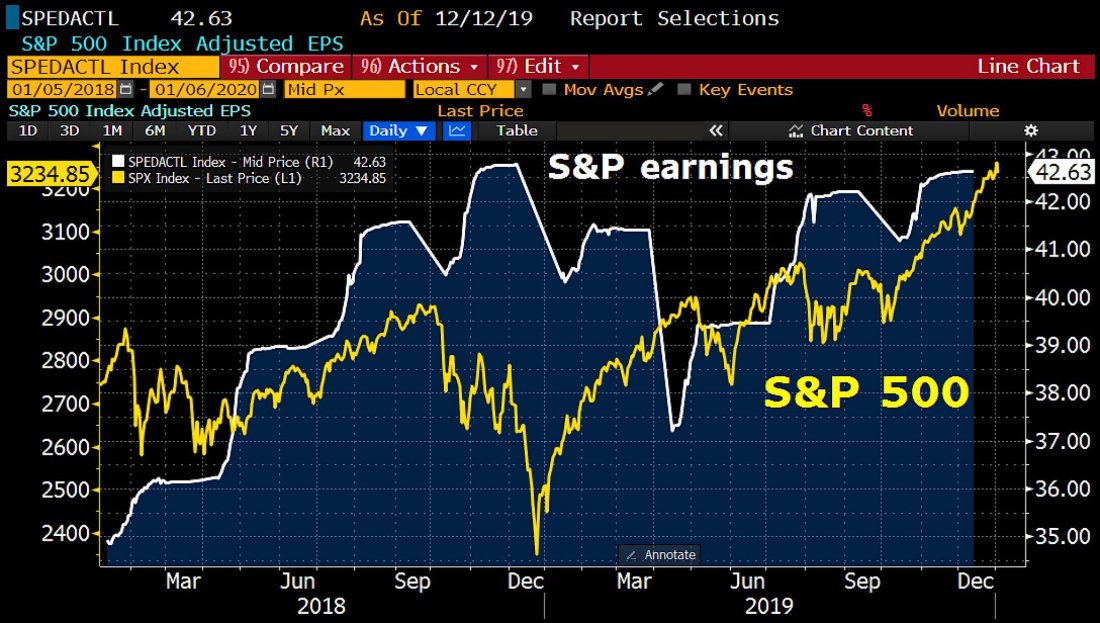
“Stocks follow earnings”, says the old adage: even in this past 2019 which has seen great returns in multiple indices, it seems to describe the market behaviour well. If one compares the S&P500 earnings with the S&P500 growth, the correlation is quite clear and an indication that this growth is not unjustified.

Photo 05-01-2020, 15.49.38

On the flipside, can the same be said about the earnings themselves ? We commented before on the fact that earnings have partly been fueled by liquidity.

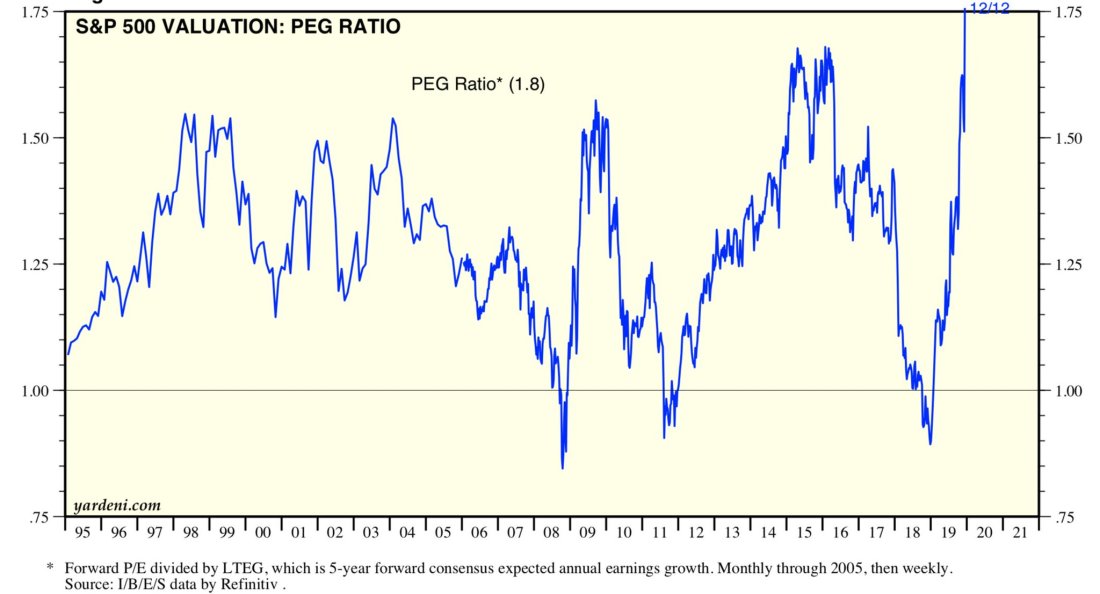
The PEG ratio of the S&P500 is much greater than 1 (with 1 meaning a future growth perfectly priced in the current stock value).

Photo 27-12-2019, 11.35.17

While earnings are the expected to grow also in 2020, a value investor will have to pick the right stocks to beat the market as the current P/E already appears to price in future earnings.

Even more now it is important to be a stock-picker. A recent example of a seemingly undervalued stock has been provided here.


It’s the #liquidity, baby

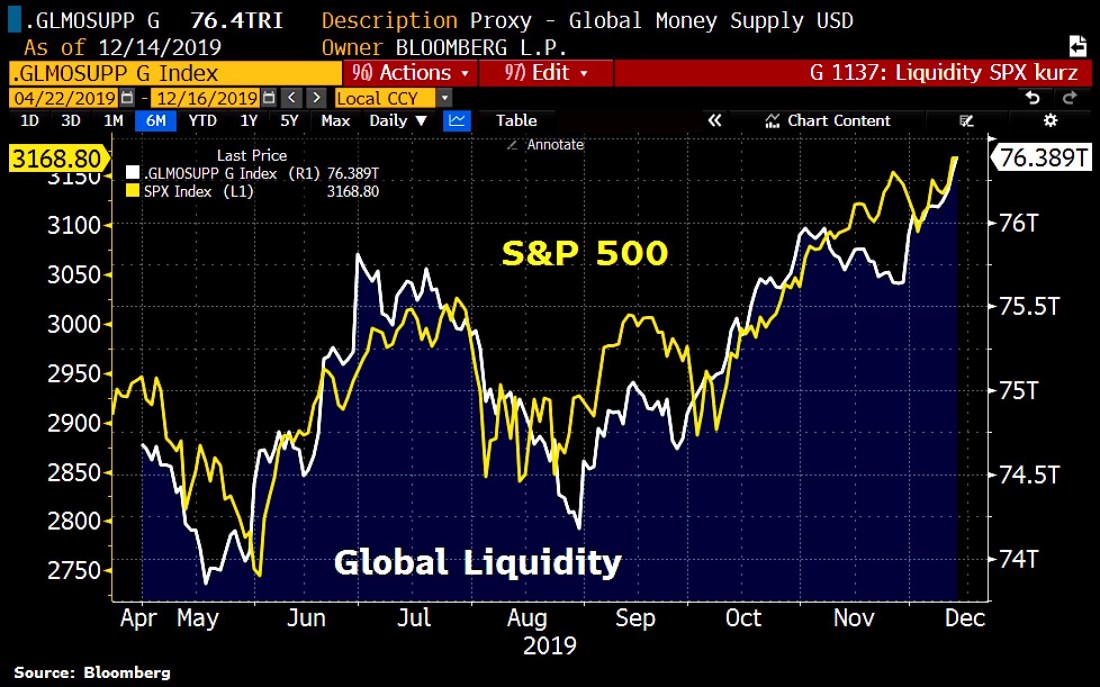
The correlation between the balance sheet and the stock market is clear, here expressed in terms of global #liquidity superimposed to the #S&P500.

Both the #ECB and the #FED have been injecting liquidity into the market which has resulted in the appreciation of #assets, rather than or only marginally in actual growth.

This is indeed the main argument against these “helicopter money” initiatives – that they result in #stock #buybacks rather than new investments aimed at growing the real economy.

How long can it last for ?

#Brystol-Myers Squibb predicts stellar #growth for 2020

Something must be stirring at #Brystol-Myers Squibb $BMY considering the projected #earnings growth for the next year. This #value company had done very little over the past years compared to the stock market until this past half of 2019. Going forward it predicts a significant #EPS #growth which makes its #PEG ratio <1. Overall it looks very promising considering it is also a generous #dividend payer.

The #US journey towards #energy independence in 2 graphs | #ActiveInvesting

The much talked about #earnings of #Google and #Facebook in two great infographics | #ActiveInvesting